

From Problems to Play
At PACT’s seventh imPACT webinar, two educators made the case that chemistry classrooms need not choose between rigor and joy — and showed exactly how to have both.
The seventh edition of PACT’s imPACT webinar series opened not with a formula or a textbook definition, but with a question: What if the problem came first? On that premise, the Philippine Association of Chemistry Teachers gathered 158 educators from across the archipelago for a Chemistry Week session themed “From Problems to Play: Transforming Chemistry Classrooms Through PBL and GBL” — a title that doubled as a manifesto.
Two speakers took the virtual stage, each representing a distinct but complementary philosophy. Together, they outlined a vision of chemistry education that begins in the messy reality of the world and ends — if all goes well — in the pleasure of
play.
F I R S T S P E A K E R
- Dr. Edwehna Elinore S. Paderna
- Professor, University of the Philippines Diliman
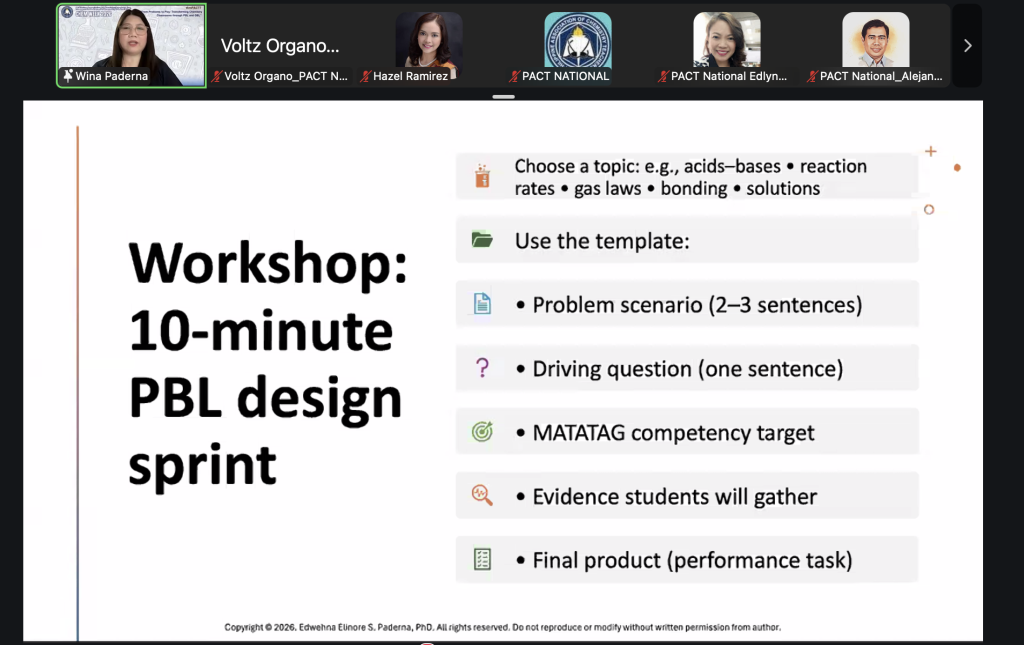
- Led the session on Problem-Based Learning (PBL) and its alignment with the MATATAG curriculum.
S E C O N D S P E A K E R
- Dr. Angelo Mark P. Walag
- Professor, University of Science and Technology of Southern Philippines
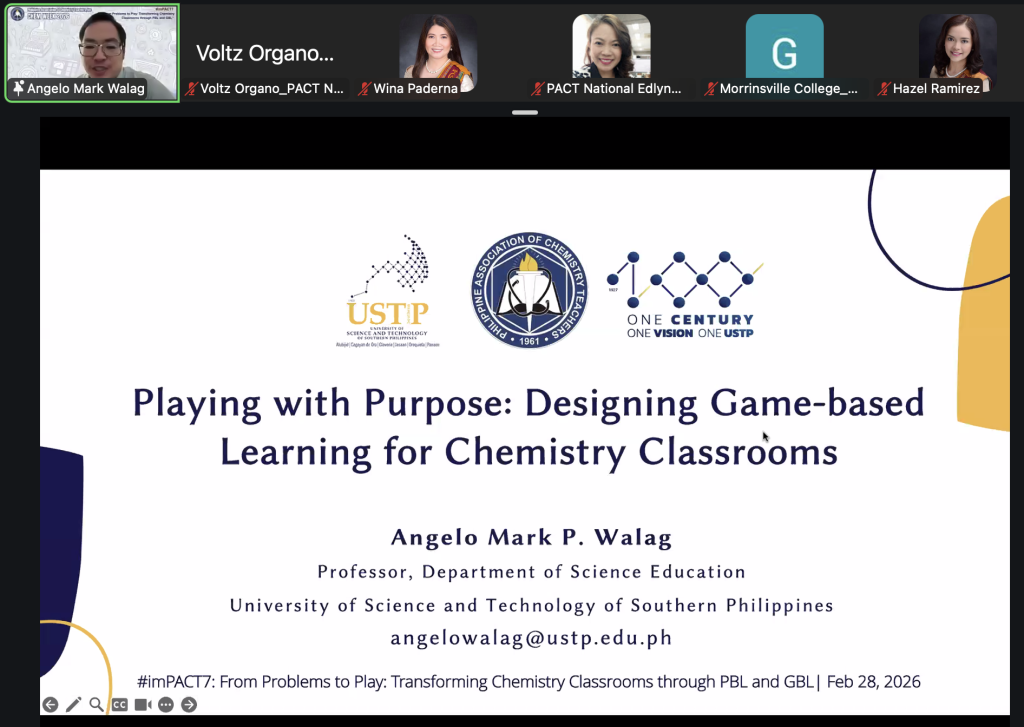
- Introduced the Game-Based Learning (GBL) model for designing purposeful educational games.
The Problem Is the Lesson
Dr. Paderna opened her session by inviting participants to do something counterintuitive: set aside the syllabus, at least for a moment, and start with a community problem instead. She presented an example rooted in the MATATAG curriculum — a water quality issue affecting a local community — and walked educators through how such a scenario could anchor an entire unit of chemistry instruction.
Her argument for Problem-Based Learning rested on four pillars: authentic problems, student ownership, inquiry, and collaboration. An effective PBL scenario, she explained, must be ill-structured enough to invite genuine investigation — not a textbook exercise with a predetermined answer — while still being carefully aligned with learning competencies. Students are not handed solutions; they are handed situations.
“Start with a real-world problem rather than definitions and formulas — let the problem pull the chemistry out of students, not push it in.”
– DR. EDWEHNA ELINORE S. PADERNA
For teachers concerned about curriculum coverage, Dr. Paderna offered a practical reassurance: begin small. A single, well-designed PBL unit — one that assesses reasoning and communication rather than rote recall — is enough to shift a classroom’s culture. She encouraged participants to design their first scenario, share it with colleagues for feedback, and iterate. The emphasis on productive struggle was consistent throughout: students who wrestle with genuine problems, she argued, learn not just chemistry but how to learn.
The session also ventured into territory that rarely appears in pedagogy workshops: artificial intelligence. Dr. Paderna urged educators to confront the reality of AI tools in students’ lives head-on, calling for explicit AI-use policies and integrity statements embedded in every assignment. Transparency, she suggested, is itself a lesson — one that models the kind of honest, evidence-driven thinking that PBL is designed to cultivate.
When the Game Is the Curriculum
Where Dr. Paderna built her session around problems, Dr. Walag built his around play — and he was careful to distinguish the two concepts he placed at the center of his talk. Gamification, he explained, is the application of game elements (points, badges, leaderboards) to existing content. Game-Based Learning is more fundamental: it means designing games that teach entire learning outcomes, in which the mechanics of play and the demands of the curriculum are inseparable. To structure that design process, Dr. Walag introduced the PLAY model — Purpose, Learning Mechanics, Agency, and Yield. Each element, he argued, must be present for a game to function as genuine pedagogy rather than a novelty activity. A bingo game for naming organic compounds, which he demonstrated live, illustrated the model in action: students weren’t memorizing by rote but connecting structural formulas to compound names through repeated, low-stakes play.
“Purposeful play is not the opposite of seriousness. It is a way to make learning both joyful and deep.”
– DR. ANGELO MARK P. WALAG
The session included a breakout activity in which groups of participants designed their own chemistry games on topics they found difficult to teach. The resulting ideas — a card game on chemical equilibrium requiring group strategy, a challenge to identify ionic and covalent bonds, and a game targeting significant figures in mathematical operations — demonstrated both the versatility of the approach and the ingenuity of the educators present. Dr. Walag offered feedback to each group, gently pushing them toward designs in which strategy, not just chance, drove learning.
A Classroom Reimagined
Taken together, the two sessions amounted to a coherent argument about what chemistry classrooms could become. Both speakers resisted the idea that engagement and rigour are in tension — that making learning more relevant, more playful, or more student-directed must come at the cost of depth. Instead, they presented PBL and GBL as mechanisms for achieving exactly the kind of thinking that chemistry education has always aspired to produce: analytical, creative, persistent, and collaborative.
For the 158 educators who attended — representing schools and universities from across the Philippines — the session closed not with a summary but with a series of invitations: to design one PBL activity before the next term, to try one game in class, to share drafts with colleagues, and to register for the events ahead.
/vgo